
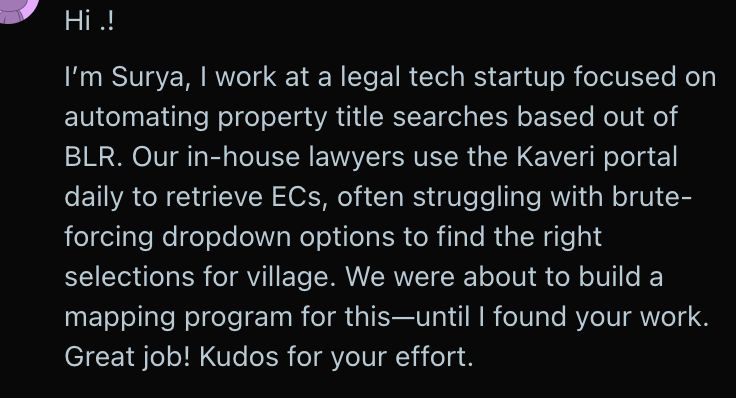
What began as the ‘EC tool’ for Bangalore has now grown into ‘Kaveri Village Finder’ for all of Karnataka. This tool solves the issue of Kaveri using a different mapping system than the one used during property registration. Huge shoutout to Abhik and Nishit for scaling it up from the prototype built by our OG volunteer, Anup! The code is now open source.
Here’s a testimonial from reader Surya.
Abhik and Nishit are working on another open-source tool to make life easier for citizens—stay tuned for updates!
This month, we put together two guides—one on transferring a BESCOM connection and another on transferring a BWSSB connection. Anup and Ayushi contributed to the fieldwork for the BESCOM guide, while Kavya took the BWSSB guide end to end—from fieldwork to authoring to designing and visually explaining the process. These two guides complete the full package of services needed for someone who has purchased a second-hand property—getting an EC for eKhata, obtaining an eKhata, and transferring electricity and water connections.
This month, two of our volunteers took on fieldwork—visiting government offices to get firsthand clarifications on key processes. Unlike researching from home, fieldwork means stepping into a government office and coaxing answers from staff who often aren’t keen to talk. Kavya tackled BWSSB meter transfer, while Ayushi focused on BESCOM meter transfer, and they had diametrically opposite experiences! Props to the staff at BESCOM Indiranagar, who welcomed Kavya’s questions.
Ayushi documented her experience here: Volunteering in Action – My Journey and Why Fieldwork Matters for Zen Citizen.
Fieldwork is the backbone of Zen Citizen. For instance, during Ayushi’s visit, a BESCOM officer mentioned that an NOC from the property owner is mandatory for transferring the name on a rental unit’s meter. Our secondary research had suggested that a rental agreement or rent receipt would suffice. But thinking about it, the NOC requirement makes sense—it ensures the owner’s consent. If we had relied solely on secondary sources, renters might have faced an extra trip to submit the NOC. This is exactly why on-the-ground verification is crucial.
This month, one of our incredible volunteers is Chandra Nath, who’s helping us build a tool to automate secondary research—unearthing valuable hacks for using government services that are often buried in forum comments. Chandra is 80 years old, and he reached out to us with an AI-generated podcast about Zen Citizen! When I need motivation to keep chipping away at Zen Citizen, I usually call other friends of Zen—but now, maybe I’ll just listen to the podcast!
We used Chandra’s v1 tool to extract details on the marriage registration process in Karnataka from websites. Now, we’re fine-tuning it to pull in insights from forums and article comments, making it even more useful.
Another volunteer this month is Nathan, a UX designer based in New York. Over the past couple of weeks, he’s had multiple brainstorming sessions with us and will be sharing UX prototypes next week!
We toyed with the idea of creating a simple site—facetiously named something like “gimmebackmymoney” or “nanna duddu vaapas beku”—where citizens could report instances of bribery, even naming the officers involved if they were comfortable. There’s no central place for this right now, and while getting the money back isn’t realistic, public ‘shaming’ could act as a deterrent if names started surfacing on social media. The plan was simple: share a Google Form, filter out junk responses, and auto-post verified reports to Twitter.
Another idea that came up was crowdsourcing reports on public officials displaying disproportionate wealth.
These experiments would have been low-cost, but verifying reports would be tricky, and we’d be opening ourselves up to bad actors misusing the platform—not to mention potential defamation lawsuits. Plus, under the Bharatiya Nyaya Sanhita Act, it’s easy to get such websites taken down.
In the end, we figured our energy would be better spent making things easier for citizens through well-crafted guides and practical tools.
VK attended the ‘RTI Museum’ talk in Chennai, hosted by Aruna Roy and Nikhil Dey, whose relentless efforts have been instrumental in shaping the RTI movement. Listening to their journey—one that has empowered countless citizens to demand accountability from the government—was truly energizing.
At the event, we got the chance to connect with Srinivasan Ramani, Deputy Editor at The Hindu, who kindly introduced us to Vignesh Radhakrishnan, head of their Data Journalism team. Vignesh generously shared rich, practical insights that will make our guide on writing RTI applications even more useful and nuanced. For instance, did you know that not knowing the exact official to address your application to isn’t necessarily a blocker for online submissions? As per Section 6(3) of the RTI Act, if an application is mistakenly sent to the wrong public authority, that authority is required to transfer it to the appropriate one and inform the applicant immediately.
VK also met Mr. PWC Davidar, advisor to TN eGovernance, who gave a deep dive into how they’ve leveraged data to drive informed decision-making in government. He built the program from scratch, skillfully navigating bureaucratic complexities—it was fascinating.
On the outreach front, VK wrote an open letter to Karnataka’s Revenue Minister, Krishna Byregowda, seeking sponsorship to facilitate top-down information collection. This would cut down the time we spend on fieldwork at local government offices, making information more accessible and helping us scale operations. We are yet to reach him, but we’ll be persistent!
Onward & Upward!
Here’s a look back at an eventful November!
Thank you all for your time, effort, and energy. It’s inspiring to see what we’re creating together. 
1.In-Person Meet-Up
2.Tools
3.Content
4.Tools and Processes
5.Volunteer Outreach
6.Website Development
7. Community Building
Looking forward to what we’ll accomplish in December!
Thank you again!